AIRMATIC 384-13 Mini Valve 382-0402
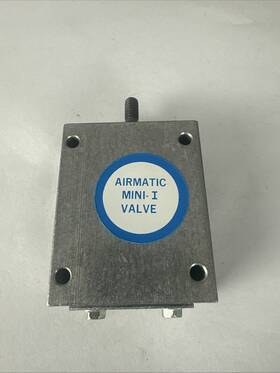
( Brand: Airmatic ), ( Manufacturer Part Number: 384-13 ), ( Part Type: Valve )
Review AIRMATIC Mini i Valve
The **Airmatic 384-13 382-0402 Mini-i Valve** is a precision-engineered, compact pneumatic control valve designed for high-performance applications where reliability, efficiency, and compact installation are critical. This valve belongs to Airmatic s **Mini-i series**, a line of miniature, yet robust, proportional control valves tailored for use in automated systems, industrial machinery, and specialized hydraulic or pneumatic circuits. With a **3/8-inch (DN10) port size**, it is ideal for applications requiring precise flow regulation, directional control, or pressure modulation in confined spaces where larger valves would be impractical. The valve operates on a **proportional principle**, allowing for smooth, adjustable control of air or hydraulic fluid flow, making it perfect for applications such as clamping systems, CNC machinery, robotics, or automated assembly lines where incremental adjustments are necessary.
Constructed from high-quality materials, the **Mini-i valve** features a **durable brass or stainless steel body**, ensuring resistance to corrosion, wear, and environmental stressors, while its compact design minimizes installation footprint without compromising performance. The valve incorporates a **piston-driven spool mechanism**, which provides fast response times and precise positioning, reducing energy consumption and improving system efficiency. Its **integrated electronic control interface** allows for seamless integration with PLCs, CNC controllers, or other automation systems via standard signal inputs, such as 0-10V, 4-20mA, or digital PWM signals, enabling fully automated and programmable operation. The valve s **low leakage design** ensures minimal air or fluid loss, contributing to overall system stability and energy savings.
One of the standout features of the **384-13 382-0402** is its **versatility in mounting options**, including **flanged, threaded, or direct-mount configurations**, making it adaptable to a wide range of system layouts. The valve s **compact yet sturdy construction** allows for easy integration into tight spaces, such as within machinery enclosures or on modular control panels, without sacrificing performance. Additionally, its **fail-safe design** whether in a normally open (NO) or normally closed (NC) configuration ensures predictable behavior in the event of power loss or system failure, enhancing operational safety. The valve s **low noise emission** and smooth operation further contribute to its suitability for applications where quiet, precise control is essential.
Maintenance of the **Airmatic Mini-i valve** is simplified by its **modular design**, allowing for easy access to internal components for cleaning or replacement. The valve s **sealed cartridge system** protects internal mechanisms from contamination, extending its operational lifespan in demanding environments. Whether used in **automotive assembly lines, medical equipment, packaging machinery, or aerospace applications**, this valve delivers consistent, high-precision control with minimal maintenance requirements. With its blend of compact size, robust construction, and advanced proportional control capabilities, the **Airmatic 384-13 382-0402 Mini-i Valve** is an excellent choice for engineers and system designers seeking a reliable, space-efficient solution for pneumatic or hydraulic automation.
The Airmatic 384-13 (382-0402 Mini-i Valve) is a compact, intelligent control valve designed for precise regulation of air or gas flow in industrial and automation applications. Below is a detailed breakdown of its pros and cons, followed by a conclusion and recommendation.
---
### **Pros of the Airmatic 384-13 (382-0402 Mini-i Valve)**
1. **Compact and Space-Efficient Design**
The Mini-i series is specifically engineered to be small and lightweight, making it ideal for installations where space is limited. This is particularly useful in retrofitting existing systems or applications with tight constraints.
2. **High Precision and Control**
The valve incorporates intelligent control technology, allowing for accurate flow regulation. It can be integrated with proportional control systems to achieve fine-tuned adjustments, which is beneficial in processes requiring consistency, such as pneumatic actuators, robotics, or automated machinery.
3. **Modular and Flexible Integration**
The valve is designed to work with Airmatic s modular control systems, including the Mini-i controller. This flexibility allows users to customize the system based on specific requirements, such as adding sensors, communication interfaces (e.g., Profibus, Modbus), or additional control logic.
4. **Energy Efficiency**
By enabling precise control of air or gas flow, the valve helps minimize waste and reduces energy consumption. This is particularly advantageous in applications where over-pressurization or excessive flow could lead to inefficiencies.
5. **Durability and Reliability**
Airmatic valves are known for their robust construction, often featuring materials like stainless steel or brass that resist corrosion and wear. The Mini-i valve, while compact, maintains this reputation for longevity, especially in controlled environments.
6. **Easy Installation and Maintenance**
The valve is designed for straightforward installation, often requiring minimal modifications to existing systems. Its compact size also simplifies access for maintenance, reducing downtime. Airmatic s reputation for user-friendly design extends to this model, with clear documentation and support resources.
7. **Compatibility with Automation Systems**
The valve can interface with PLCs (Programmable Logic Controllers) and other automation platforms, making it suitable for modern industrial setups. This compatibility is enhanced by its digital communication capabilities, which allow for remote monitoring and control.
8. **Quiet Operation**
Compared to larger valves, the Mini-i valve operates more quietly, which can be a significant advantage in environments where noise reduction is important, such as in cleanrooms or office-adjacent industrial spaces.
9. **Cost-Effective for Small-Scale Applications**
For applications where a full-scale control system is unnecessary, the Mini-i valve offers a cost-effective alternative. Its compact size and targeted functionality make it a practical choice for niche or specialized tasks without the overhead of larger systems.
10. **Support and Warranty**
Airmatic is a well-established brand with a global support network. The Mini-i valve likely comes with a warranty, and access to technical support, spare parts, and training can be easier to obtain compared to lesser-known brands.
---
### **Cons of the Airmatic 384-13 (382-0402 Mini-i Valve)**
1. **Limited Flow Capacity**
As a mini valve, its flow capacity is inherently restricted. If your application requires high-volume or high-pressure regulation, this valve may not be sufficient, and you would need to consider larger models or additional valves in parallel.
2. **Higher Cost Relative to Basic Valves**
While the Mini-i valve offers advanced features, it is more expensive than standard mechanical valves or even basic pneumatic valves. The cost may not be justified for simple on/off applications where precision control is unnecessary.
3. **Dependence on Airmatic s Ecosystem**
The valve s full potential is realized when integrated with Airmatic s controllers or other compatible components. If you are already invested in a different brand s control system, compatibility might require additional adapters or interfaces, adding complexity and cost.
4. **Potential Learning Curve**
The intelligent features of the Mini-i valve, such as proportional control or digital communication, may require training for operators or technicians unfamiliar with such systems. This could lead to initial inefficiencies or errors if the team lacks experience with advanced pneumatic controls.
5. **Limited Customization for Extreme Conditions**
While the valve is durable, it may not be suitable for extreme environments, such as high-temperature applications, corrosive chemicals, or high-vibration settings, without additional protective measures or modifications. Always verify the valve s specifications against your operating conditions.
6. **Dependence on Power Supply**
The intelligent features of the valve require a power source (e.g., 24V DC). In applications where power is unreliable or unavailable, you may need to invest in backup power solutions, adding to the system s complexity.
7. **Potential for Overkill in Simple Applications**
For basic pneumatic systems where simple on/off control is sufficient, the advanced features of the Mini-i valve may be unnecessary, leading to higher upfront costs without proportional benefits.
8. **Availability and Lead Times**
As a specialized component, the Mini-i valve may have longer lead times compared to standard valves. Additionally, finding authorized distributors or technicians familiar with this model could be challenging in some regions.
9. **Maintenance Complexity**
While the valve is designed for ease of maintenance, its intelligent components (e.g., sensors, electronics) could introduce points of failure that require more specialized knowledge to diagnose and repair compared to purely mechanical valves.
10. **Limited Documentation or Community Support**
Depending on the region, access to detailed technical documentation, user forums, or community support for the Mini-i valve might be limited. This could make troubleshooting or optimization more difficult for users without direct access to Airmatic s support channels.
---
### **Conclusion**
The Airmatic 384-13 (382-0402 Mini-i Valve) is a highly capable, compact valve suited for applications requiring precise, intelligent control of air or gas flow in constrained spaces. Its strengths lie in its precision, modularity, energy efficiency, and compatibility with automation systems, making it ideal for modern industrial, robotic, or automated machinery applications. However, its limitations such as limited flow capacity, higher cost, and dependence on Airmatic s ecosystem must be carefully considered.
This valve is best suited for:- Applications where space is limited and precision control is critical.
- Systems that can benefit from integration with Airmatic s controllers or other automation platforms.
- Users who prioritize long-term efficiency, reliability, and scalability over basic on/off functionality.
It may not be the best choice for:- High-volume or high-pressure applications where larger valves are required.
- Simple, low-cost pneumatic systems where advanced features are unnecessary.
- Environments with extreme conditions that exceed the valve s specified operating limits.
---
### **Recommendation**
**Buy the Airmatic 384-13 (382-0402 Mini-i Valve if:**1. Your application demands precise, proportional control of air or gas flow in a compact setup.
2. You are already using or planning to integrate Airmatic s control systems or compatible automation platforms.
3. The valve s energy efficiency and long-term reliability align with your operational goals.
4. You have the technical expertise or are willing to invest in training to operate and maintain the intelligent features of the valve.
5. The cost is justified by the valve s benefits in your specific use case, and you have verified that its flow capacity meets your requirements.
**Avoid the Airmatic 384-13 (382-0402 Mini-i Valve if:**1. Your application only requires basic on/off control, and a simpler, cheaper valve would suffice.
2. You operate in an extreme environment where the valve s specifications are not fully compatible.
3. You lack access to Airmatic s support or have no intention of integrating with their ecosystem.
4. The valve s higher cost does not align with your budget, and alternative solutions (e.g., larger valves or different brands) offer comparable performance at a lower price.
5. Your team lacks experience with intelligent pneumatic control systems, and the learning curve would introduce unnecessary complexity.
**Alternative Considerations:**- If precision is not critical, explore standard proportional valves from brands like SMC, Festo, or ASCO, which may offer simpler solutions at a lower cost.
- For high-flow applications, consider larger Airmatic valves (e.g., the 384 series without the "mini" designation) or other industrial-grade valves like those from Parker or B rkert.
- If budget is a constraint, evaluate whether a used or refurbished Mini-i valve is available, though ensure it comes with a warranty or performance guarantee.
Ultimately, the Airmatic 384-13 (382-0402 Mini-i Valve is a strong choice for targeted applications where its advanced features provide clear advantages. Conduct a thorough cost-benefit analysis and ensure compatibility with your existing systems before making a purchase decision.
Details:
As Shown in Pictures.
part #: 38413 prices
- $19.99-$29.99
specifications valvesplumbing:
- brand: Airmatic
- mpn: 384-13
- part type: Valve
seller valvesplumbing:
- rating: 99.5%
- # reviews: 17948
- city: North Street, Michigan
offer valvesplumbing:
- quantity: 1
- availability: In Stock
- sold: 0
- options: Ship-to-home
- started: May 8, 2026
- best offers: True
returns valvesplumbing:
- method: Money back
- time: 30 Days
- paid by: Buyer
- policy: Returns Accepted
shipping valvesplumbing:
- carrier: USPS
- cost: $0.00
- type: Fixed
- service: USPS Ground Advantage
- transit: 5-11 Days
- class: Standard
general valvesplumbing:
- condition: Used
- Hydraulics, Pneumatics, Pumps Plumbing > Valves Manifolds > Other Valves Manifolds
payments valvesplumbing:
- credit card: Visa
- other
- wallet: Paypal
Airmatic 384-13 Is Similar To:
- Bb-21384 Airmatic Solenoid Valve (47.9% similar) BB w solenoid valve 24VDC. Airmatic-allied inc...(March 4th, 2018)
- Lexair Inc Airmatic Allied V3w3x-26 Solenoid Valve (40.4% similar) V3W3X26 solenoid valve orig: 1/32-1/32 120V dc 105PSI 0.5W. Manufacturers warranty and support do not apply...(September 8th, 2024)
- Airmatic Valve Inc 1063xnc Inc Solenoid 10 60 Volts Plus 11063-rx (26.4% similar) It is paired with the 11063-RX valve for specific applications in hydraulics, pneumatic, and other industrial settings. Model 1063XNC, designed to operate at a voltage range of 10/60 volts...(January 13th, 2025)
