EATON VICKERS DGMX1-3-PP-BW-B-40-EN12 Control Valve 109A116PR2
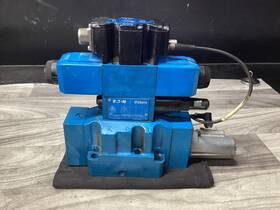
( Brand: Eaton Vickers ), ( Manufacturer Part Number: DGMX1-3-PP-BW-B-40-EN12 ), ( Part Type: Control Valve ), ( Country Of Origin: United Kingdom )
Review EATON VICKERS System Control Valve #109a116pr2
The **Eaton Vickers DGMX1-3-PP-BW-B-40-EN12** is a high-performance, precision-engineered **direct-acting pilot-operated control valve** designed for demanding hydraulic and industrial applications where reliability, efficiency, and consistent flow regulation are critical. Part of Eaton Vickers advanced **DGX series**, this valve is engineered to deliver exceptional performance in systems requiring precise control of fluid flow, pressure, and directional changes. The **109A116PR2** designation indicates a specific model variant within the DGX family, optimized for applications where compact yet robust construction, low leakage, and quick response times are essential.
This valve operates on a **direct-acting pilot principle**, meaning it combines the responsiveness of a direct-acting mechanism with the stability of a pilot-assisted system, ensuring rapid and accurate actuation while minimizing energy loss. The **DGMX1-3** designation suggests a **3-way, pilot-operated design**, ideal for applications such as clamping, holding, or sequencing operations where fluid must be directed, metered, or isolated with precision. The **PP** suffix indicates a **proportional pilot control**, allowing for smooth, variable flow regulation rather than simple on/off operation, making it suitable for applications requiring gradual adjustments in pressure or flow rate.
The **BW-B** designation denotes a **burst-resistant, spring-return pilot mechanism**, which enhances durability and ensures consistent performance even under transient pressure spikes or system surges. This feature is particularly valuable in industrial environments where hydraulic systems may experience sudden load changes or pressure fluctuations. The **40** in the model number likely refers to the **nominal port size**, which in this case corresponds to a **1/2-inch (12.7 mm) connection**, providing a balanced flow capacity for medium-duty applications while maintaining compactness.
Compliance with **EN12** standards underscores the valve s adherence to European hydraulic system regulations, ensuring compatibility with industrial machinery, mobile hydraulics, and other applications where safety, interoperability, and performance consistency are non-negotiable. Constructed from high-quality materials, including **durable steel housings, corrosion-resistant coatings, and precision-machined internals**, this valve is built to withstand harsh operating conditions, including exposure to contaminants, temperature variations, and high-pressure cycles.
The **DGMX1-3-PP-BW-B-40-EN12** is particularly well-suited for applications in **industrial automation, material handling, press systems, and hydraulic actuators**, where precise control over fluid dynamics is required. Its **low internal leakage** and **fast response time** make it an excellent choice for systems where efficiency and reliability are paramount, reducing downtime and improving overall system performance. Whether integrated into a **hydraulic press, clamping mechanism, or automated manufacturing process**, this valve delivers the robustness and precision needed to meet the demands of modern industrial hydraulics.
### **Pros and Cons of buying a Eaton Vickers DGMX1-3-PP-BW-B-40-EN12 Control Valve (109A116PR2)**
#### **Pros:**1. **High Reliability and Durability** Eaton Vickers is a well-established brand known for manufacturing robust hydraulic and pneumatic control valves. This valve is designed for industrial applications, ensuring long-term performance under demanding conditions.
2. **Precision Engineering** The DGMX series is known for its tight tolerances and smooth operation, making it suitable for applications requiring precise flow control, such as hydraulic systems in machinery, automotive testing, or aerospace simulations.
3. **Wide Compatibility** The valve is designed to work with various hydraulic fluids and pressures, making it versatile for different industrial setups. The **EN12 certification** suggests compliance with European safety and performance standards, which can be beneficial for global applications.
4. **Modular and Customizable** The **PP (Proportional Pilot)** variant allows for electronic control, enabling variable flow rates and pressure adjustments, which is useful in automated systems. The **BW-B** designation likely indicates a specific mounting or connection type, offering flexibility in system integration.
5. **Energy Efficiency** Proportional control valves optimize hydraulic system performance by reducing energy waste, leading to cost savings over time.
6. **Warranty and Support** Eaton Vickers is part of a larger industrial conglomerate (Caterpillar s Eaton division), meaning access to technical support, spare parts, and warranty coverage is likely reliable.
7. **Industrial-Grade Build** The **40** in the model number may refer to a specific pressure rating (e.g., 400 bar), indicating it is built for high-pressure applications without compromising safety.
---
#### **Cons:**1. **High Initial Cost** As a premium industrial component, this valve will likely be more expensive than generic or aftermarket alternatives. The cost may be a barrier for small businesses or startups with tight budgets.
2. **Complex Installation and Maintenance** Due to its advanced features (proportional control, hydraulic integration), installation may require specialized knowledge. Maintenance could also demand trained personnel, adding operational costs.
3. **Potential Overkill for Low-Demand Applications** If the valve is being purchased for a system with minimal flow requirements, its advanced capabilities may be unnecessary, leading to wasted investment.
4. **Dependence on Hydraulic System Compatibility** The valve must match the existing hydraulic system s pressure, flow rate, and fluid type. Mismatches could lead to inefficiency or damage.
5. **Limited Availability of Spare Parts** While Eaton Vickers has a strong support network, some specialized components may take longer to source compared to more common valve brands.
6. **Learning Curve for Operation** Proportional control valves require familiarity with electronic and hydraulic tuning, which may require training for operators unfamiliar with such systems.
7. **Potential for Overengineering** For applications where simpler, less expensive valves (e.g., manual or pilot-operated) would suffice, this valve may offer unnecessary complexity.
---
### **Conclusion:**The **Eaton Vickers DGMX1-3-PP-BW-B-40-EN12 (109A116PR2)** is a high-quality, precision control valve ideal for industrial applications requiring **reliable, proportional hydraulic control**. Its strengths lie in **durability, precision, and compatibility with advanced systems**, making it a strong choice for manufacturing, testing, or automation environments where performance is critical.
However, its **high cost, complexity, and potential overkill for simpler applications** mean it may not be the best fit for budget-conscious or low-demand setups. Businesses should carefully assess their **specific requirements, system compatibility, and long-term cost-effectiveness** before purchasing.
### **Recommendation:** - **Buy if:**- You need a **high-performance, proportional control valve** for an industrial hydraulic system.
- Your application demands **precision, reliability, and compliance with EN12 standards**.
- You have the **budget and technical expertise** to install and maintain it properly.
- The valve will be used in **high-pressure or automated environments** where efficiency is key.
- **Consider Alternatives if:**- Your application is **low-pressure or low-flow**, where a simpler valve (e.g., manual or pilot-operated) would suffice.
- Budget constraints make this valve **too expensive** compared to other options.
- Your team lacks **experience with proportional control valves**, requiring extensive training.
For most **heavy-duty industrial, automotive, or aerospace applications**, this valve is a **strong, long-term investment**. For smaller or less demanding systems, exploring **lower-cost, simpler alternatives** may be more practical. Always consult with a hydraulic specialist to ensure the valve aligns with your system s exact needs.
Details:
part #: dgmx13ppbwb40en12 prices
- $199.95-$1010.00
specifications valvesplumbing:
- brand: Eaton Vickers
- mpn: Dgmx1-3-pp-bw-b-40-en12
- part type: Control Valve
- country of origin: United Kingdom
seller valvesplumbing:
- city: Scottsburg, Indiana
- # reviews: 2004 6
- rating: 99.9%
returns valvesplumbing:
- policy: No Returns
payments valvesplumbing:
- credit card: Diners-club
- wallet: Google-pay
- other
- cash
shipping valvesplumbing:
- class: Standard
- carrier: USPS
- type: Fixed
- transit: 4-8 Days
- cost: $0.00
- service: USPS Ground Advantage
general valvesplumbing:
- condition: Used
- Valves Manifolds > Directional Control Valves > Stack Valves
offer valvesplumbing:
- quantity: 1
- sold: 0
- best offers: True
- started: March 20, 2026
- options: Ship-to-home
- availability: In Stock
Eaton Vickers DGMX1-3-PP-BW-B-40-EN12 Is Similar To:
- 02-119590 Vickers Eaton (25.8% similar) 4MM mounting type: manifold, width : 71. 2MM electrical connection: top exit flying leads orifice size. Vickers Eaton DG4S4LW 016C b directional control valve - solenoid actuation, 4-WAY, D05 valve, 20 GM max flow, 110 v ac 50 Hz 60 coil actuation type: solenoid wiring housing terminal box with ...(October 29th, 2018)
- 02-144984 Eaton Vickers Hydraulic Valve (42.2% similar) 2, height in. 34 holding amps, GM psi 10, max. Hydraulic directional valve, solenoid operated, CETOP-03 size, number of ways 4, tandem spool type, coil volts 110-120VAC, 50 60 Hz. Pressure psi 5075, max. 6, DG4, ISO standards. 6, width in. Tank pressure psi 3045, fluorocarbon seal type, ...(September 28th, 2017)
- 02-178268 Eaton Victors Vickers Rev Screw In Cartridge Valve New (43.3% similar) ...(February 13th, 2019)
- 02-337014 Vickers Eaton Hydraulic Directional Control Valve (38.8% similar) ...(September 11th, 2018)
- 145407 Eaton Df Airflex Valve Quick (32.4% similar) If are looking to combine shipping, please send a note through. This item is to be installed and maintained by qualified individuals. E-mail any questions. Items include only what you see in the photo, if need an accessory that is not pictured ask. Shipping costs are based on rate, packaging ...(September 26th, 2018)
- 234488 Vickers Eaton Es17 Pm (28.6% similar) Eaton Vickers ES17 pm subplot dags 01X 10 hydraulic valve...(February 4th, 2018)
- 307aa00037a Vickers Eaton Cartridge Relief Valve (37.3% similar) New cartridge valve Vickers ships quickly...(April 15th, 2018)
- 317226 Dg4s4010a50 Vickers Eaton Directional Valve Pilot Used (35.1% similar) Vickers Eaton DG4S4010A50 directional valve pilot 2PCS used. Dimensions: approximately long x high. 4-WAY flow DG4S4 010A 50 unit part number solenoid coil 115VAC. Used, pulled from a working environment. Industrial application. Torque screws: 30-35 lb in. Solenoid actuated...(February 11th, 2019)
- 730408 Eaton Vickers Cover New (38% similar) The item available here is a new Eaton Vickers cover that in excellent condition. Location: AGS-G2...(October 28th, 2018)
- 871471 Eaton Vickers Hydraulic Valve (43.4% similar) 6, DG4, ISO standards. Pressure psi 5075, max. 2, height in. Hydraulic directional valve, solenoid operated, CETOP-03 size, number of ways 4, closed spool type, coil volts 110-120VAC, 50 60 Hz. 34 holding amps, GM psi 21, max tank pressure 3045, fluorocarbon seal type, length in, width...(September 28th, 2017)
- At-6914 Eaton New Five Valve Stems For Pressure Testing Nos Nib (27.1% similar) New box of Eaton 5 f valve stems from the 1970 S or early 1980 S are in at for pressure testing...(April 22nd, 2018)
