PARKER PLJ-C10 Subbase Logic Elements PLN-C10 PLK-C10
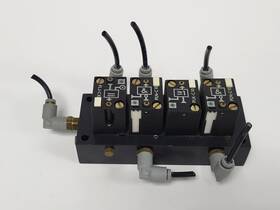
( Brand: Parker ), ( Manufacturer Part Number: PLJ-C10 ), ( Part Type: Logic ), ( Suitable Media: Air ), ( Country Of Origin: United States )
Review PARKER Subbase Mounted Logic Elements
The **Parker Hannifin PLJ-C10 Subbase Logic Elements** comprising the **PLN-C10 (Normally Closed), PLK-C10 (Normally Open), and PLJ-C10 (Subbase)** represent a robust and versatile family of pneumatic logic components designed for precise control and automation in industrial, manufacturing, and process applications. Engineered with Parker s signature reliability and precision, these elements operate as the foundational building blocks of pneumatic logic circuits, enabling seamless integration into larger control systems where logic-based decision-making is critical. The **PLJ-C10 Subbase** serves as the central mounting and connection hub, providing a stable platform for modular assembly, allowing users to configure custom logic sequences by stacking the **PLN-C10 (Normally Closed)** and **PLK-C10 (Normally Open)** elements in series or parallel configurations. Each element is constructed from high-quality, corrosion-resistant materials, including durable aluminum and stainless steel components, ensuring longevity even in harsh environments where exposure to moisture, dust, or temperature fluctuations is common. The **PLN-C10** and **PLK-C10** feature Parker s **Logic Elements** technology, which utilizes a sealed, diaphragm-operated mechanism to provide clean, leak-free operation while maintaining high switching speeds and consistent performance under repeated cycling. These components are ideal for applications requiring **AND, OR, NOT, or sequential logic functions**, such as in packaging machinery, material handling systems, or automated assembly lines, where precise pneumatic actuation is essential for efficiency and safety. With a compact yet sturdy design, the PLJ-C10 Subbase accommodates up to three logic elements, allowing for flexible reconfiguration without the need for additional mounting hardware, while its integrated quick-connect ports facilitate easy integration with Parker s broader range of pneumatic actuators, valves, and cylinders. Whether used in standalone logic circuits or as part of a larger control architecture, these elements deliver dependable, repeatable performance, minimizing downtime and maximizing productivity in demanding industrial environments.
### **Parker PLJ-C10 Subbase Logic Elements (PLN-C10, PLK-C10) Pros and Cons**
#### **Overview**
The **Parker PLJ-C10** is a modular, programmable logic controller (PLC) designed for industrial automation, featuring **PLN-C10 (network module)** and **PLK-C10 (keyboard module)** as part of its ecosystem. It is part of Parker s **Hannifin** line of automation solutions, known for reliability in harsh environments. Below is a detailed analysis of its advantages and limitations.
---
### **Pros**
1. **Modular and Scalable Design**
- The PLJ-C10 is built on a modular architecture, allowing users to expand functionality by adding input/output (I/O) modules, communication interfaces, and other logic elements (PLN-C10 for networking, PLK-C10 for human-machine interface integration).
- Supports growth without replacing the entire system, making it cost-effective for evolving industrial needs.
2. **High Reliability in Industrial Environments**
- Designed for **harsh industrial conditions**, including temperature extremes, vibration, and electrical noise.
- Robust enclosure options and compliance with **IP65/IP67** standards ensure durability in factories, oil & gas, and other demanding settings.
- Redundancy features (e.g., dual-power supply options) minimize downtime.
3. **Flexible Communication Protocols**
- Supports **Ethernet/IP, Modbus TCP, PROFINET, and other industrial protocols** via the PLN-C10 network module, enabling seamless integration with SCADA, MES, and other enterprise systems.
- Compatibility with **Parker s ControlLogix and CompactLogix** platforms allows for hybrid automation setups.
4. **Programmability and Logic Flexibility**
- Uses **Parker s proprietary logic software** (or compatible with third-party tools like **RSLogix, FactoryTalk, or Codesys**) for custom logic programming.
- The PLK-C10 keyboard module provides a **local HMI interface** for troubleshooting and monitoring, reducing reliance on external devices.
5. **Energy Efficiency and Low Total Cost of Ownership (TCO)**
- Optimized power consumption compared to traditional PLCs, reducing operational costs.
- Long lifespan and minimal maintenance requirements contribute to **lower long-term expenses**.
6. **Support for Advanced Automation Features**
- Capable of handling **motion control, safety logic, and predictive maintenance** applications.
- Integration with **Parker s servo drives and actuators** enhances precision in motion-intensive processes.
7. **Global Compliance and Certifications**
- Meets **CE, UL, ATEX, and IECEx** standards, ensuring compliance in regulated industries (e.g., food & beverage, pharmaceuticals, oil & gas).
- Suitable for **explosive environments** (with appropriate certifications).
8. **Technical Support and Documentation**
- Parker Hannifin provides **dedicated technical support**, training, and extensive documentation for implementation.
- Access to **updates and firmware patches** ensures compatibility with evolving industry standards.
---
### **Cons**
1. **Higher Upfront Cost**
- Compared to **basic PLCs** (e.g., Allen-Bradley Micro800, Siemens LOGO), the PLJ-C10 and its modules (PLN-C10, PLK-C10) are **more expensive**.
- The modular nature may require additional budgeting for optional I/O or communication modules.
2. **Complexity for Small-Scale Applications**
- Overkill for **simple control tasks** (e.g., basic motor starters, small conveyor systems) where a **low-cost PLC or relay logic** would suffice.
- Steeper learning curve for **non-experienced engineers** due to advanced features.
3. **Vendor Lock-In Risks**
- Heavy reliance on **Parker s ecosystem** (software, modules, support) may limit flexibility if switching to another brand (e.g., Siemens, Rockwell).
- Proprietary programming tools may require additional training or licensing.
4. **Limited Open-Source or Third-Party Integration**
- Unlike **open-source PLCs (e.g., OpenPLC, Ignition)**, the PLJ-C10 has **limited compatibility with non-Parker software**.
- Custom scripting or advanced AI/ML integration may require workarounds.
5. **Dependence on Parker s Support Network**
- If local Parker distributors are unavailable, **troubleshooting or spare parts may face delays**.
- Some regions may have **limited after-sales service** compared to global brands like Siemens or ABB.
6. **Software Dependency**
- Performance and updates rely on **Parker s logic software**, which may not always be as intuitive as alternatives (e.g., **FactoryTalk View Studio**).
- Licensing costs for advanced software features can add to expenses.
7. **Physical Size and Installation Constraints**
- The modular design requires **more rack space** compared to compact PLCs.
- Installation may be **more complex** in space-constrained environments.
---
### **Conclusion**
The **Parker PLJ-C10 with PLN-C10 (network) and PLK-C10 (keyboard) modules** is a **high-performance, scalable, and reliable PLC solution** ideal for **large-scale industrial automation, motion control, and complex logic applications**. Its strengths lie in **durability, flexibility, and integration capabilities**, making it suitable for industries requiring **high availability and compliance with strict standards**.
However, it is **not the best choice** for **small-scale or budget-sensitive projects**, where simpler or more cost-effective PLCs would be preferable. The **higher initial cost, vendor dependency, and complexity** may deter smaller operations or those with limited technical resources.
### **Recommendation**
- **Buy the PLJ-C10 system if:**- You require **industrial-grade reliability** in harsh environments.
- Your application demands **scalability, advanced networking (Ethernet/IP, PROFINET), and motion control**.
- You are already using **Parker s ecosystem** (e.g., drives, sensors, HMI systems).
- Long-term **cost efficiency and low maintenance** are priorities.
- **Avoid the PLJ-C10 if:**- Your project is **small-scale or low-budget** (consider **Allen-Bradley Micro800, Siemens LOGO, or Omron CP1E** instead).
- You need **open-source flexibility or third-party software compatibility**.
- Local **Parker support and spare parts availability** are questionable.
- You prefer **simpler, plug-and-play PLCs** with minimal programming complexity.
For most **mid-to-large industrial automation projects**, the PLJ-C10 is a **strong, well-supported choice**. However, **careful cost-benefit analysis** is essential to ensure it aligns with your specific requirements.
Details:
In some circumstances, a 20% return shipping deduction may apply.: Used items will show signs of use. Join us in the circular economy and a sustainable future. Please see the images.
Functional - Pulled from a working system. Scuffs, scratches, small dings and etc. E-commerce transportation accounts today for 3% of global greenhouse gas emissions but is on track to become 17% by 2050. A62.1 RE031926.
As seen in pictures.
part #: pljc10 prices
- $39.95-$99.99
specifications valvesplumbing:
- brand: Parker
- mpn: Plj-c10
- part type: Logic
- suitable media: Air
- country of origin: United States
shipping valvesplumbing:
- type: Fixed
- carrier: UPS
- transit: 4-8 Days
- cost: $0.00
- class: Standard
- service: UPS Ground
payments valvesplumbing:
- credit card: Diners-club
- wallet: Google-pay
- other
returns valvesplumbing:
- method: Money back
- policy: Returns Accepted
- time: 60 Days
- paid by: Seller
seller valvesplumbing:
- # reviews: 17911
- rating: 99.9%
- city: Riverside, California
general valvesplumbing:
- condition: Used
- Hydraulics, Pneumatics, Pumps Plumbing > Valves Manifolds > Other Valves Manifolds
offer valvesplumbing:
- quantity: 1
- options: Ship-to-home
- sold: 0
- started: March 19, 2026
- availability: In Stock
Parker PLJ-C10 Is Similar To:
- B511ach53c Parker Series Valve Position Inline Subbase New (30.3% similar) Parker B5G1ACB53C b5 series valve 2 position inline subbase new part: this items is in oem packaging box my have small rips it comes with warranted, buy confidence...(October 21st, 2018)
- Parker B33h000xxc B3 Series Subbase Mounted 4-way Valve (48.3% similar) This unit will arrive in the condition shown. Orders are shipped to the cardholders billing address. 4-WAY, 2 position, 1/4 not, pilot actuator. Power cords and power adapters are never included unless specifically mentioned. Parker B33H000XC b3 series subbase mounted 4-WAY valve: this lot is for ...(October 26th, 2024)
- Parker Telepneumatic Pll-a1 Add Logic Switch P9231 (43.2% similar) 3:00 pm est is the shipping cut-off time. By buying on this item you accept the previously stated conditions. Parker PLL-A1 add logic switch. These are industrial surplus, excess or unneeded inventory and typically shelf worn, sometimes without boxes, marked tagged with identification excesses due ...(December 29th, 2024)
- Parker Telepneumatic Plk-a1 Gt et Logic Switch P9230 (44.2% similar) 3:00 pm est is the shipping cut-off time. These are industrial surplus, excess or unneeded inventory and typically shelf worn, sometimes without boxes, marked tagged with identification excesses due that in their condition they can not be sold retail. Parker PLK-A1 gt/ET logic switch. By buying on ...(December 29th, 2024)
- Parker Ns800s-12mb Needle Valve Sub-plate Mounted 3000psi (42.4% similar) Valve bodies and manifolds. Safety and security. Needle valves. Pressure regulator valves. Tool storage...(June 27th, 2025)
- Parker Pse-a12 Pneumatic Logic Processor Head And Tail 4mm Swivel 3-8bar (37.6% similar) Address, next day automation, 9472 hemlock lane specifications: model #: PSE-A12. Logic function: 6MM swivel push-in. If you do not have an account no worries. This is a surplus item. Rated pressure: 3-8BAR...(October 20th, 2025)
- Parker Plk-a11 Telepneumatics Logic shuttle Valve module Pneumatic Used (40.9% similar) The items in the order will have their warranty found null and void. India Pakistan. Items marked as: for parts or repair /or as is are not covered by the 30 day warranty. Units not tested. Part/ model Nebr: PLK-A11. This specifically applies to items marked as: new, new open box and used these are ...(November 18th, 2025)
