STNC TG3531B-10C Manual Pneumatic Air Control Valve 0-1.0MPA
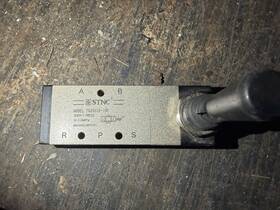
( Brand: Stnc ), ( Manufacturer Part Number: TG3531B-10C ), ( Part Type: Pneumatic Control Valve Manual ), ( Suitable Media: Air ), ( Valve Operation: Manual ), ( Maximum Pressure: 0-1.0mpa )
Review STNC Manual Pneumatic Air Control Valve
The **STNC TG3531B-10C** is a high-performance **manual pneumatic air control valve** designed for precise regulation of compressed air flow within industrial, automation, and pneumatic control systems. Engineered to operate within a pressure range of **0 to 1.0 MPa (0 to 10 bar)**, this valve combines robust construction with advanced pneumatic actuation to deliver reliable and efficient air management. Its **direct-acting design** ensures smooth and consistent control, making it ideal for applications requiring fine-tuned adjustments in pneumatic cylinders, actuators, or other air-powered mechanisms. The valve features a **durable brass or stainless steel body**, depending on the specific model variant, ensuring resistance to corrosion and prolonged operational life in demanding environments. Its **pneumatic pilot control** allows for remote or automated activation, enhancing system flexibility and reducing manual intervention. The **1/4-inch NPT or 1/8-inch G thread connections** provide versatile compatibility with standard piping systems, while the **sealed piston or diaphragm mechanism** minimizes air leakage, optimizing energy efficiency. Whether integrated into a manufacturing line, automated assembly process, or HVAC system, the **STNC TG3531B-10C** delivers dependable performance with minimal maintenance, making it a trusted choice for engineers and technicians seeking precision and durability in pneumatic control solutions.
### **Pros and Cons of buying a STNC TG3531B-10C Manual Pneumatic Air Control Valve (0-1.0 MPa)**
#### **Pros:**1. **Precision Control** The manual pneumatic valve allows for fine-tuned regulation of airflow, making it suitable for applications requiring consistent pressure or flow rates.
2. **Durability and Reliability** STNC is a reputable brand known for manufacturing high-quality industrial valves. This model is likely built to withstand frequent use in demanding environments.
3. **Wide Pressure Range (0-1.0 MPa)** The valve is designed to handle moderate to high-pressure applications, offering flexibility for various pneumatic systems.
4. **Manual Operation** Unlike fully automated valves, this model allows for manual adjustment, which can be useful for troubleshooting, testing, or systems where automation is not required.
5. **Compatibility with Pneumatic Systems** It integrates seamlessly with standard pneumatic circuits, making it a practical choice for air-operated machinery, compressors, or control systems.
6. **Cost-Effective for Basic Needs** Compared to fully automated or smart valves, this manual model may be more affordable while still providing effective control.
7. **Easy Installation and Maintenance** Many pneumatic valves of this type are designed for straightforward installation and minimal upkeep, reducing downtime.
8. **Safety Features** The manual override ensures that operators can intervene if automated systems fail, improving safety in critical applications.
#### **Cons:**1. **Lack of Automation** Since it is manually operated, it requires human intervention for adjustments, which can be inefficient in continuous or high-speed production environments.
2. **Potential for Human Error** Misadjustments by operators could lead to inconsistent performance or system malfunctions if not properly monitored.
3. **Limited Integration with Smart Systems** Unlike digital or programmable valves, this model cannot be easily integrated into IoT or automated control networks.
4. **Wear and Tear Over Time** Manual valves may experience more wear from frequent adjustments compared to fully automated counterparts.
5. **Pressure Limitations** At 1.0 MPa, it may not be suitable for extremely high-pressure applications requiring specialized valves.
6. **Dependence on Operator Skill** Proper operation requires trained personnel, which could be a drawback in environments with high turnover or limited expertise.
7. **No Built-In Diagnostics** Unlike smart valves, this model does not provide real-time feedback on performance or potential failures.
8. **Potential Leakage Risks** If not properly maintained, manual valves can develop leaks, leading to air loss and inefficiency.
---
### **Conclusion**
The **STNC TG3531B-10C manual pneumatic air control valve** is a solid choice for applications where **manual control, durability, and moderate pressure handling (0-1.0 MPa) are prioritized**. It excels in **cost-effective, low-to-moderate automation environments** where human oversight is feasible and where precision is required without the need for full automation.
However, if the system requires **automation, real-time monitoring, or high-speed adjustments**, a fully automated or smart valve would be more appropriate. Additionally, industries with **strict safety or efficiency standards** may prefer valves with built-in diagnostics or fail-safes.
---
### **Recommendation**
**Buy this valve if:**- You need a **reliable, manual-controlled pneumatic valve** for moderate-pressure applications.
- Your system does not require full automation but benefits from precise airflow regulation.
- Budget constraints make automated valves impractical.
- The valve will be used in **stable, low-to-moderate demand environments** where manual adjustments are manageable.
**Consider alternatives if:**- You require **automated or smart valve control** for efficiency and monitoring.
- The application involves **high-pressure or extreme conditions** beyond 1.0 MPa.
- Your system is **highly automated**, and manual intervention is impractical.
- You need **remote or programmable control** for better integration with modern industrial setups.
For most **basic pneumatic control needs where cost and simplicity are key**, this valve is a **practical and dependable choice**. However, assess whether the lack of automation aligns with your operational requirements before purchasing.
Details:
STNC TG3531B-10C Manual Pneumatic Air Control Valve, MPN TG3531B-10C, 0-1.0MPa.
part #: tg3531b10c price
- $149.95
specifications valvesplumbing:
- brand: Stnc
- mpn: Tg3531b-10c
- part type: Pneumatic Control Valve Manual
- suitable media: Air
- valve operation: Manual
- maximum pressure: 0-1.0mpa
seller valvesplumbing:
- rating: 100.0%
- # reviews: 2
- city: Fresno, California
returns valvesplumbing:
- policy: No Returns
offer valvesplumbing:
- sold: 0
- quantity: 1
- best offers: True
- availability: In Stock
- started: March 16, 2026
- options: Ship-to-home
payments valvesplumbing:
- other
- wallet: Apple-pay
- credit card: Discover
general valvesplumbing:
- Hydraulics, Pneumatics, Pumps Plumbing > Valves Manifolds > Air Control Valves
- condition: Used
shipping valvesplumbing:
- service: USPS Ground Advantage
- type: Calculated
- carrier: USPS
- cost: $5.52
- transit: 5-12 Days
- class: Standard
